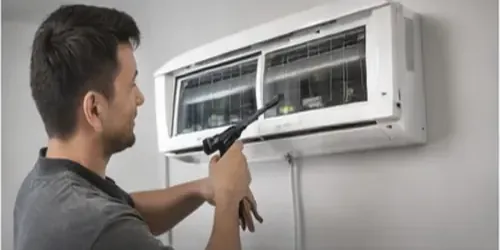
Wall Mount
Split Unit Installation
Wall-mounted and ceiling cassette split-unit air conditioners for homes and offices.

Installers who size the unit to the room instead of the budget — across South Africa.
Installation quality matters more than the brand
HVAC covers systems that differ considerably in complexity. Through our contractor network the scope includes split unit air conditioning, ducted air conditioning, VRV and VRF systems, servicing and repairs and HVAC maintenance. A single wall-mounted split and a multi-zone VRV installation are different undertakings requiring different qualifications, and matching properly avoids sending a domestic installer to a commercial job.
Installation matters more than brand on air conditioning, which is the opposite of what most buyers assume. Two units of identical specification, one installed carefully and one rushed, will differ substantially in efficiency, noise and lifespan. The workmanship in the pipework, the vacuum drawn before charging, and the condensate drainage all determine how the unit performs, and none of it is visible once the covers go on.
The electrical supply is a separate trade and a common gap between quotes. A dedicated circuit and isolator for an air conditioner is fixed electrical work requiring a registered electrician, even where the HVAC contractor arranges it. Establish who is doing that part and whether it is included, because it is regularly assumed by both sides and priced by neither. Older properties may also need board capacity checked before adding the load.
The most useful thing to compare on air conditioning quotes is not the unit but what surrounds it — pipe run length and routing, whether the electrical supply is included, how condensate is drained, and what commissioning is done. Two quotes naming the same model can differ substantially on all four. We publish no rates, and equipment is priced by the contractor. Tell us the rooms and how they are used and we will match you with contractors covering your area.
Moisture in the system damages it slowly
Evacuating the pipework before charging is the step most often shortened. Air and moisture left in a refrigerant system degrade the oil, corrode components internally and reduce efficiency, and the damage is gradual enough that it is never attributed to the installation. A proper vacuum takes time on site with a gauge to prove it, which is exactly why it gets rushed when an installer has three jobs that day.
Condensate drainage is the commonest cause of call-backs and water damage. An indoor unit produces a surprising amount of water, and if the drain has insufficient fall, runs uphill anywhere along its length, or discharges somewhere it will block, the water finds its way onto a ceiling instead. Ask where the condensate goes and whether it falls consistently the whole way.
Outdoor unit placement affects both efficiency and neighbours. A condenser in an enclosed space or against a wall with no clearance recirculates its own hot air and works harder for the same cooling, while one under a bedroom window transmits noise that becomes an issue in a complex or a close-set suburb. Vibration through mounting brackets carries into the structure as well, which is why bracket choice and isolation matter more than they appear to.
Ask for commissioning readings in writing. A properly commissioned installation has recorded figures — operating pressures, temperature differential across the coil, and confirmation that a vacuum was achieved — and a contractor who takes them is one who did the steps. It costs nothing to request and tells you more about the installation than any warranty document. We publish no rates. Tell us the rooms and we will match you with contractors covering your area.
Refrigerant is not consumed — losing it means a leak
Refrigerant is not consumed in normal operation, which means a system needing a top-up has a leak. Contractors who simply recharge without finding the leak are selling you the same gas repeatedly, and the leak continues. If cooling capacity has dropped, the correct response is to locate the leak, repair it, then recharge — not to add gas annually as though it were a consumable.
Filters and coils account for most avoidable efficiency loss. A choked filter restricts airflow, forcing the unit to run longer for the same effect and increasing running cost measurably, while an outdoor coil packed with dust cannot reject heat properly. Both are straightforward to clean and are the main content of a routine service. In dusty conditions the interval needs shortening rather than following a generic schedule.
Oversizing shows up in the running cost rather than in comfort. A unit larger than the room needs cools quickly, reaches setpoint, switches off, and repeats — and that short cycling uses more energy than steady running while never dehumidifying properly, leaving a room that feels cold and clammy rather than comfortable. It also wears the compressor faster. This is why sizing calculations matter and why bigger is not safer.
The number worth knowing about air conditioning is the one on your electricity bill, not the one on the quote. A correctly sized inverter unit running steadily in a well-sealed room costs a fraction of an oversized conventional unit short cycling in a room with an open door, and that difference compounds every month for years. We publish no equipment rates. Tell us the rooms and how they are used and we will match you with contractors covering your area.
Complete heating, ventilation and air conditioning solutions.
Wall-mounted and ceiling cassette split-unit air conditioners for homes and offices.

Central air systems with ducting for whole-home or commercial building climate control.
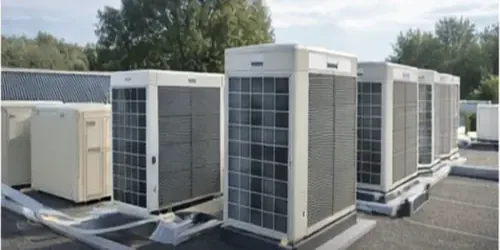
Variable refrigerant systems for large commercial and multi-zone applications.

Filter cleaning, gas top-ups, fault diagnosis and preventive maintenance.
An oversized or undersized system wastes energy and fails early — sizing matters.
A well-designed HVAC system pays for itself in energy savings and occupant comfort. Whether you need a single-room split unit or a commercial multi-zone system, correct installation by a trained technician is the difference between a system that works reliably for 15 years and one that needs constant attention.
Our contractors supply and install all major brands, and offer service plans to keep your system performing at peak efficiency.
Sizing is where most air conditioning money is wasted. A unit chosen by room area alone ignores glazing, orientation, ceiling height and insulation, and the result is either a system that never reaches setpoint or one that short-cycles and fails early. West-facing rooms with large windows routinely need a size up from what a rule of thumb suggests. Ask what calculation was used, and be sceptical of a quote produced without anyone seeing the room.
Find our verified contractors across all major areas and suburbs in your province.
No areas listed yet.
No areas listed yet.
Also covering
No areas listed yet.
No areas listed yet.
No areas listed yet.
No areas listed yet.