Ceramic
Floor & Wall Tiling
Ceramic, porcelain and natural stone tiling for bathrooms, kitchens and living areas.

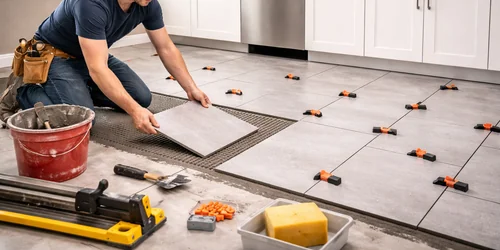
Levels checked before the first tile goes down — flooring across South Africa.
Different floor types are genuinely different trades
Tiling and flooring covers materials that behave in completely different ways. Through our contractor network the scope includes tiling, flooring and carpet fitting, spanning ceramic and porcelain, natural stone, timber, laminate and vinyl. A tiler who is excellent with large-format porcelain is not automatically the right person to lay solid timber, and we match on the material.
Setting out decides how a tiled floor reads, and it happens before a single tile is bedded. A good tiler establishes where the cuts will land, keeps them away from doorways and focal points, and centres the layout on what the eye follows rather than on an arbitrary corner. Poor setting out produces slivers at the most visible edge, and it cannot be corrected afterwards.
Material choice should follow the room rather than the showroom. Slip resistance matters in bathrooms, entrances and around pools, and a tile that looks superb in a display becomes a hazard when wet. Large-format tiles need a flatter substrate than standard sizes and are less forgiving of an uneven floor. Underfloor heating, pets and heavy traffic all narrow the sensible options further.
We do not publish tiling or flooring prices. The material itself, the amount of preparation the existing floor needs, tile size and layout complexity, and the local contractor rate all change the figure — and rates run lower in smaller towns than in the metros. Tiles, timber, adhesive and screed are priced by the contractor for your job, not estimated by us. Tell us the rooms and the material you have in mind and we will match you with contractors covering your area.
Materials that move with humidity and temperature
Timber, laminate and engineered board all move with humidity, which is why installation allows for it. Boards need acclimatising in the room before laying so they reach equilibrium with the conditions they will live in, and skipping that step produces gapping in winter or buckling in summer regardless of how carefully they were fitted.
Subfloor moisture destroys more wood-based floors than anything else. A concrete slab that has not fully dried, or one without an effective damp proof membrane below it, will drive moisture upward into whatever is laid on top. Testing the slab before installation takes very little time and prevents a failure that is only fixable by lifting the entire floor.
Material choice should follow the room's moisture conditions. Solid timber is beautiful and least tolerant of moisture, engineered board is considerably more stable, and vinyl or LVT handles bathrooms, kitchens and laundries where wood simply cannot. Underlay matters too — it affects sound transmission in upstairs rooms, comfort underfoot, and how well minor substrate irregularities are absorbed.
We do not publish flooring prices. Material cost varies enormously between laminate, engineered board and solid timber, subfloor preparation is unknown until the existing floor is assessed, and underlay, beading and thresholds all add. Rates differ by area as well. Materials are priced by the contractor for your job. Tell us the rooms and the look you want and we will match you with contractors covering your area.
Grout is not waterproof and was never meant to be
Grout is not a waterproofing layer, and treating it as one is why showers leak. Grout fills the joint and resists water, but the waterproofing membrane beneath the tiles is what actually keeps water out of the structure. A shower tiled beautifully over inadequate waterproofing will leak, and the leak will be blamed on the grout.
Silicone belongs where movement happens and grout belongs everywhere else. Internal corners, the junction between wall and floor, and around baths and trays all move slightly, and rigid grout in those positions cracks within the first year. A tiler who grouts internal corners has saved a little time and created a maintenance problem.
Falls to the drain are set before tiling begins, in the screed. A shower floor that does not fall consistently toward the outlet holds water in the low spots regardless of how the tiles are laid, and correcting it afterwards means lifting the floor. Natural stone adds another consideration, needing sealing before grouting to prevent staining and periodically thereafter.
We do not publish wet-area tiling prices. Waterproofing specification, screed work to establish falls, tile choice and the complexity of the detailing all change the cost, and rates differ by area. Membrane, tiles, grout and sealant are priced by the contractor for your job. Tell us what you are tiling and we will match you with contractors covering your area.
Complete flooring solutions from screed to final polish.
Ceramic, porcelain and natural stone tiling for bathrooms, kitchens and living areas.

Sand-cement and self-levelling screeds to create a flat, solid tile substrate.

Click-lock laminate installation on underlay for a warm, durable interior floor.

Luxury vinyl tile and sheet vinyl — waterproof, durable and available in wood looks.

Solid and engineered timber floors installed, sanded and finished on site.
Almost every flooring failure comes from poor substrate preparation, not the tiles themselves.
Flooring is one of the highest-traffic elements in any building — it needs to be installed on a solid, level substrate to perform well and look good for years. Whether you are tiling a wet room, laying a large-format porcelain throughout an open-plan home, or installing hardwood in a bedroom, preparation is everything.
Our flooring contractors assess the substrate, prepare it correctly, and install with the care that keeps floors looking new years later.
Almost every flooring complaint we handle traces back to the substrate. Tiles that drum underfoot or lift at corners usually had poor adhesive coverage or went onto a slab that was not level; laminate that peaks at the joins was laid without an expansion gap at the walls. None of this is visible on handover day, which is why it is worth paying for the screed and preparation stage rather than only comparing the price per square metre of the finish.
Find our verified contractors across all major areas and suburbs in your province.
No areas listed yet.
No areas listed yet.
Also covering
No areas listed yet.
No areas listed yet.
No areas listed yet.
No areas listed yet.